
The recent announcement of the imminent creation of more Integrated Business Units (IBU) by the Department for Transport Operator (DFTO)[1], led to a speculation where a continuation of this theme may lead. The announcement that the operator Thameslink would combine with Network Rail’s Sussex Route and West Midlands Railway with the Central Route are the next stages in the slowly emerging puzzle of the structure of GBR. Since GBR has not given out details of what is planned next, this IPEX Insight takes a short delve into some possibilities.
The current, understood, plan is to form regional based integrated business units. This looks like it has been done to avoid reorganising Network Rail which could be a mammoth task. Network Rail is still organised around the historic Big Four groupings. The Railways Act 1921 grouped 120 of the independent railway companies into four – the Great Western Railway (GWR), London Midland and Scottish Railway (LMS), London North Eastern Railway (LNER), and the Southern Railway (SR).
These became the BR Regions in 1948 with a new Scottish Region created taking the Scottish parts of the LMS and LNER, and LNER being split into Eastern (south) and North Eastern (north). Later Eastern and North Eastern recombined but then in 1988 Anglia was established as a Region separate from Eastern. There have been some other changes to the boundaries over the years, most notably Wales which was split between London Midland and Western, first having the boundary moved south which swapped the Cambrian lines from Western to London Midland, and then later becoming its own Route as a whole. Similarly, the South Western parts of the Southern became part of Western, but in essence the boundaries today can be traced to those drawn out 105 years ago.
The wisdom of a regionalised structure for GBR is yet to be proven but lessons from history are mixed. In the early, pre-Grouping, days of the railways, efficient regional operation, such that existed, did not have to compete with other transport modes. The Big Four never really had time to deliver on the improvements promised by Grouping before WW2 broke out and the railways were brought under emergency national control, which morphed post-war into British Railways in 1948. BR only became an efficient railway after changing from Regions to Sectorisation in 1982[2].
However, laying aside that debate for another day, what will this regional structure look like? Table 1 shows the IBUs which have been set up to date with their Network Rail organisation and train operating companies (TOCs).
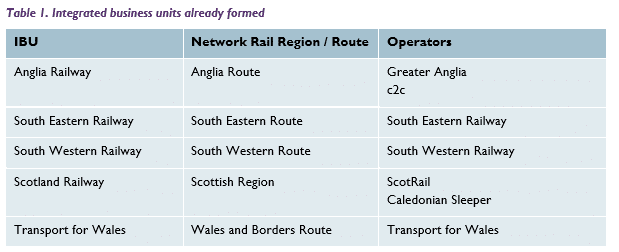
Table 2 shows the IBUs that are expected to be formed, made up of the ones already announced and the ones that are an obvious fit between TOC and Network Rail Route.

Finally, Table 3 shows IPEX speculation on what the other IBUs may be. In it, it has been suggested that a West Coast Main Line Route should be created by combining West Coast South with the WCML part of North West Route. This would be similar to the East Coast Route which is dedicated to the East Coast Main Line. This would make sense as the maintenance and operation of the WCML is distinctly different from the rest of the North West Route with tight geometry and maintenance standards to enable the Class 390 tilting trains to operate.
The second speculation is to combine the North West Route (minus the WCML) with the North East Route to form a new Northern Region. This would align much better with the Northern and Trans-Pennine Express (TPE) operations, rather than trying to split the operator, Northern, back into its North East and North West guises just to fit the Routes, which would still leave TPE crossing both.

This, however, does leave Cross Country Trains and East West Rail route-less. These are prime examples to highlight one of the problems with Regional based operations.
In the days of the Big Four and BR Regions, the NE-SW cross-country services were operated by LNER south to Banbury, Oxford, or Swindon where a locomotive change would enable a GWR locomotive to take the train on. With the introduction of fixed formation units, unless the service is split with passengers having to change, this methodology does not work.
There are arguments to fit Cross Country Trains into any of the many IBUs that their trains operate over – GWR, West Coast, West Midlands, East Midlands and LNER. Given the current centre of operations for Cross Country is Birmingham, one of West Coast or West Midlands probably makes the most sense. Expiry of the core term of the contract is on 17 October 2027 unless it is brought forward so this does give time for a decision to be made.
East West Rail crosses Anglia Railway, East Midlands Railway, and West Midlands Railway territory. It is likely that the best solution is for East West Rail to become part of West Midlands Railway given it is opening from there eastwards.
The completion of this reorganisation results in twelve business units which seems to be a lot for what is supposed to be a single organisation. Two of these are managed by their local devolved Government entity which has been assured to stay the same. This leaves ten in England which still seems far too many.
It would be prudent to introduce a Stage 2 in the GBR evolution to amalgamate the IBUs into Regional control. Table 4 outlines what this could look like. The Western Route and Wales & Borders Route have been promoted into Western Region and Wales & Borders Region as them continuing to be a combined Region makes little sense.

This distils the IBUs to seven which leaves English GBR with five Regions, one more than the previous Big Four, caused by the addition of the Northern Region. This seems a reasonable end point which would enable a pragmatic combining of track and train while minimising the re-organisational impact which is likely to be felt for many years to come.
Much is made of history and historic precedents. The future of our railways is indelibly linked to its past and this is to be embraced. This is perhaps best demonstrated in that, if the speculation outlined here were implemented, even after 190 years, the Great Western Railway would retain its identity and its route!
[1] Next integrated business units planned for later this year, Wilcock, R, RAIL magazine, 29 April 2026 accessed on 30 April 2026 from https://www.railmagazine.com/news/next-integrated-business-units-planned-for-later-this-year?
[2] In search of the sustainable subsidy, Ford, R, Modern Railway Insight, 28 April 2026, accessed on 30 April 2026 from https://www.modernrailwaysinsight.com/view_article.asp?ID=9419 (subscription required)