
IPEX Consulting Ltd
Outline Sustainability Plan and Carbon Report
1 Commitment to achieving Net Zero
2 Reporting Periods
IPEX Consulting Ltd developed a Carbon Reduction Plan and began reporting on Carbon Emissions in September 2020. IPEX Consulting Ltd’s financial reporting year (FY) runs from September to August; the same period shall be used for measuring and reporting greenhouse gas emissions.
3 Baseline Emissions Footprint
Baseline emissions are a record of the greenhouse gases that have been produced in the past and were produced prior to the introduction of any strategies to reduce emissions. Baseline emissions are the reference point against which emissions reduction can be measured.
| Baseline Year: 2020-21 | |
| Additional Details relating to the Baseline Emissions calculations. | |
| This is the first year that IPEX Consulting has formally calculated its CO2 emissions and therefore forms the baseline year. | |
| Baseline year emissions: | |
| EMISSIONS | TOTAL (tCO2e) |
|---|---|
| Scope 1 (Fuel combustion, company vehicles, fugitive emissions) | IPEX Consulting Ltd does not directly own, lease or operate any company vehicles and does not directly purchase fuel. Total, Scope 1 = 0 tCO2/year |
| Scope 2 (Purchased electricity, heat and steam) | IPEX Consulting Ltd does not directly purchase electricity, heat or steam. Employees work from their home address and a small, 2 desk fully serviced office is leased in central London, energy and other utilities are included in the rental for this fully serviced office. Total, Scope 2 = 0 tCO2/year |
| Scope 3 Purchased goods and services, business travel, employee commuting, waste disposal, use of sold products, transportation and distribution (up- and downstream), investments, leased assets and franchises. | Purchased goods No new IT equipment or stationery was purchased during this financial year. Purchased services Fully serviced office accommodation at 222 Regent Street (B rated for energy consumption, emits 129,724.25 kgCO2/year, IPEX has 2 of 435 desks) means emissions were 596.4 KgCO2. Home working Home energy consumption attributable to home working by employees (average of 11 employees, 37 hours / week, heated for half year which is 23.5 weeks, one third of employees would heat house anyway for another occupant, assume fuel is natural gas, 5kWh to heat home for an hour, gas emissions factor is 0.184 KgCO2/kWh) means emissions were 5,869 KgCO2. IT Equipment (average of 11 employees, 37 hours / week, 47 weeks / year, 0.2kW consumption, 0.256 kg of CO2e per kWh) means emissions were 979.4 KgCO2. Lighting (average of 11 employees, 37 hours / week, 47 weeks / year, 0.01kW consumption, 0.256 kg of CO2e per kWh) means emissions were 49 KgCO2. Business travel Reduced levels of business travel in FY2020-21 due to Covid-19 restrictions. Travel by rail (2,300 km total, from ORR 0.1465 KgCO2/passenger-km) means emissions were 336.95 KgCO2. Travel by private car (3,360 km total, 0.120KgCO2 / km) means emissions were 403.2 KgCO2. Travel by plane – none in FY2020-21 Commuting Significantly reduced levels of commuting in FY2021-22 due to Covid-19 restrictions. Travel by rail (2,000 km total, from ORR 0.1465 KgCO2/passenger-km) means emissions were 293 KgCO2. Travel by private car (800 km total, 0.120KgCO2 / km) means emissions were 96 KgCO2. Investments Interest bearing bank accounts only - nil Other leased assets None Total, Scope 3 = 8.622 tCO2/year |
| Total Emissions 8.622 tCO2/year | |
4 Current Emissions Reporting
| Reporting Year: 2024-25 (Completed in Sept 2025, following end of financial year 2024-25) | |
| EMISSIONS | TOTAL (tCO2e) |
|---|---|
| Scope 1 (Fuel combustion, company vehicles, fugitive emissions) | IPEX Consulting Ltd does not directly own, lease or operate any company vehicles and does not directly purchase fuel. Total, Scope 1 = 0 tCO2/year |
| Scope 2 (Purchased electricity, heat and steam) | IPEX Consulting Ltd does not directly purchase electricity, heat or steam. Employees work from their home address and a 6 desk fully serviced office is leased in central London, energy and other utilities are included in the rental for this fully serviced office. Total, Scope 2 = 0 tCO2/year |
| Scope 3 (Purchased goods and services, business travel, employee commuting, waste disposal, use of sold products, transportation and distribution (up- and downstream), investments, leased assets and franchises) | Purchased goods 4 refurbished laptops at 32 KgCO2, means total emissions were 128 KgCO2. Purchased services Fully serviced office accommodation at 222 Regent Street (B rated for energy consumption, IPEX has 6 of 435 desks) emissions calculated by Fora to be 982 KgCO2. Home working Home energy consumption attributable to home working (office equipment and heating) by employees (average of 10 employees, 37 hours / week, 47 weeks / year, emits 0.333 total kg CO2e / FTE working hour) means emissions were 5,790.87 KgCO2. Lighting (average of 10 employees, 37 hours / week, 47 weeks / year, 0.01kW consumption, emits 0.177 kg of CO2e per kWh) means emissions were 30.78 KgCO2. Business travel Travel by rail (76,265.6 km total, from ORR emits 0.035 KgCO2 / passenger-km) means emissions were 2,669.3 KgCO2. Travel by London Underground (665.6 km total, emits 0.027 KgCO2 / passenger-km) means emissions were 17.97 KgCO2. Travel by private car, including taxis (8610.56 km emits 0.173 KgCO2 / km + 922.88 emits 0.148 KgCO2 / passenger-km) means emissions were 1,626.22 KgCO2. Travel by plane (5,299 km x average passenger short-haul emits 0.12576, + 68,090 km x average passenger long-haul emits 0.31656) means emissions were 22,220.97 KgCO2. Commuting Travel by rail (0 km total, from ORR 0.035 KgCO2 / passenger-km) means emissions were 0 KgCO2. Travel by underground (4,332 km total, from 0.027 KgCO2 / passenger-km) means emissions were 116.9 KgCO2. Travel by private car (0 km total, 0.215KgCO2 / km) means emissions were 0 KgCO2. Investments Interest bearing bank accounts only - nil Other leased assets None Total, Scope 3 = 33.583 tCO2/year |
| Total Emissions 33.583 tCO2/year | |
5 Emissions reduction targets
Our reportable carbon emissions have increased from 8.622 tCO2e in the baseline year to 33.583 tCO2e in the current reporting year FY2024/25. This rise is primarily attributed to four principal factors:
- The baseline year was established during the COVID-19 pandemic, when travel activity and associated emissions were significantly lower than typical operating levels;
- Significant growth in air travel due to project commitments in Australasia, with long-haul flights more than doubling in the reporting year;
- A 16% increase in domestic rail travel compared to the previous year;
- Growth in the organisation workforce from 10 to 13 employees during the reporting period, contributing to increased operational activity and travel demand.
Regression against our emission targets is illustrated in the graph below:
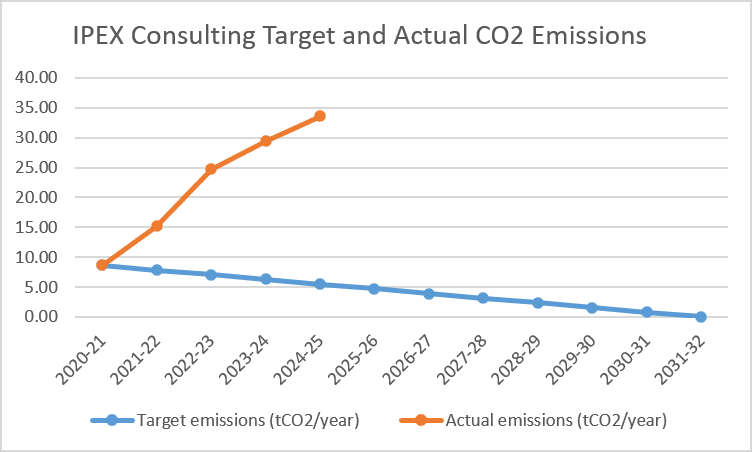
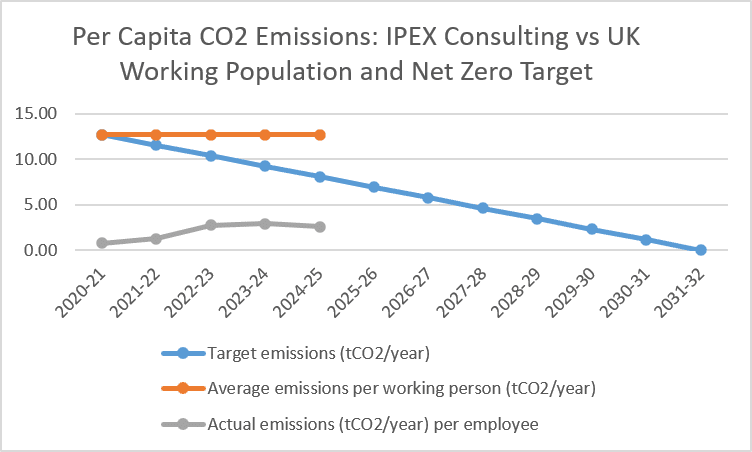
Looking ahead, we anticipate that business travel will remain elevated, and headcount is forecast to continue increasing. In response, we have shifted our focus from total emissions to a per capita emissions metric.
For context, the average UK working individual has an annual carbon footprint of approximately 12.7 tCO2e. While our current per-employee figure has risen since the baseline year—partly due to the relaxation of COVID-19 restrictions and a return to business-as-usual operations—it remains significantly lower than the UK average at 2.58 tCO2e per employee. This demonstrates that, despite recent increases, we are still performing well relative to the national average.
6 Carbon Emissions Reduction Initiatives
IPEX Consulting has embedded carbon reduction within its wider sustainability approach. The measures below focus on the main sources of operational emissions and on practical actions that can be maintained as the business grows. Measures introduced before the 2020-21 baseline, including the environmental policy and changes to travel and expenses practices, remain in effect for future contracts.
Smarter ways of working:
- Maintain a remote and flexible working model to reduce commuting and office-related emissions;
- Use digital-first working practices to minimise paper consumption, resource use and avoidable waste;
- Encourage efficient use of energy in home and office working environments.
Sustainable travel
- Use video conferencing and remote collaboration tools to avoid unnecessary travel;
- Prioritise public transport and rail, and encourage walking and cycling where practicable;
- Reduce reliance on flights, private cars and taxis where suitable lower-carbon alternatives are available, while recognising that some project commitments require travel;
- Support lower-carbon commuting choices through initiatives such as cycle-to-work schemes.
Responsible procurement
- Favour energy-efficient, durable and sustainable products, including refurbished equipment where appropriate;
- Avoid unnecessary purchases and consider waste, energy use and whole-life environmental impact when sourcing goods and services;
- Encourage suppliers and business partners to adopt responsible and sustainable practices.
Influence through project delivery
- Promote decarbonisation and sustainable outcomes across rail and wider transport projects;
- Share knowledge through insights, publications and industry engagement;
- Consider environmental outcomes in project delivery and decision-making, recognising that IPEX can create positive impact through the work it supports as well as through its own operations.
Measurement, collaboration and continuous improvement
- Measure and review environmental performance, set clear reduction targets and monitor progress;
- Continue aligning the environmental management approach with recognised standards, including ISO 14001;
- Review policies, practices and behaviours as the business, workforce and travel profile change;
- Encourage employees and associates to adopt sustainable behaviours and work with clients, suppliers and community initiatives to promote responsible practices.
7 Declaration and Sign Off
This Carbon Reduction Plan has been completed in accordance with PPN 006 and associated guidance and reporting standard for Carbon Reduction Plans.[1]
Emissions have been reported and recorded in accordance with the published reporting standard for Carbon Reduction Plans and the GHG Reporting Protocol corporate standard and uses the appropriate Government emission conversion factors for greenhouse gas company reporting.[2]
Scope 1 and Scope 2 emissions have been reported in accordance with SECR requirements, and the required subset of Scope 3 emissions have been reported in accordance with the published reporting standard for Carbon Reduction Plans and the Corporate Value Chain (Scope 3) Standard.[3]
This Carbon Reduction Plan has been reviewed and signed off by the board of directors (or equivalent management body).
Get in touch
Trust us to accelerate your vision
Established in 2003, IPEX has a wide client and project base in global rail and transport consultancy. Our team has a combined wisdom of over 200 years’ working with major blue chip rail organisations, covering all aspects of rail operations, maintenance, and projects. Talk to us today and see how we can help you.
This site is protected by reCAPTCHA and the Google Privacy Policy and Terms of Service apply.